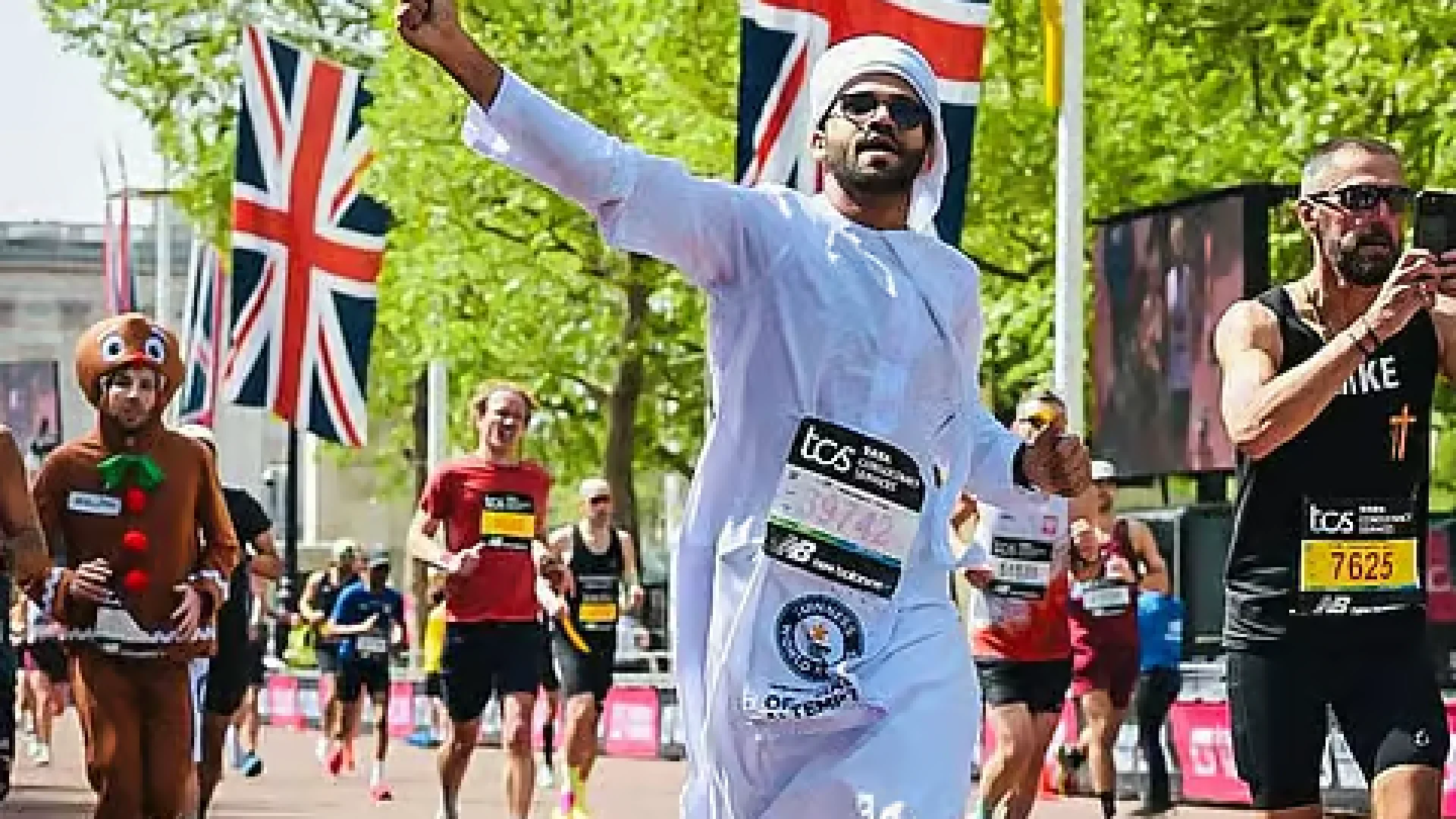
On the chilly streets of Greenwich, amid neon singlets and carbon-plated shoes, one runner stood out in pure white: a kandura flowing at his knees. The UAE resident completed the London Marathon 2025 wearing the traditional Gulf robe and secured a Guinness World Records title for the fastest marathon run in a kandura. It’s a feat that turns fabric into symbolism—identity carried at pace, endurance tested in plain sight. What looks effortless in photos becomes a 42.195-kilometre negotiation with heat, wind, friction, and willpower.
The first thing you hear isn’t footsteps. It’s cloth.
A soft, persistent flutter—like a small sail catching London’s morning breeze—threads through the soundscape of the start line. Thousands of runners bounce in place, shaking out legs, adjusting bibs, checking watches. Everything is technical. Everything is tight. And then there’s one man in white, calm as a page before ink.
“You’re really running in that?” a runner beside him asks, eyebrows lifted over mirrored sunglasses.
He smiles, small and certain. “Yes. All the way.”
London Marathon day is famous for spectacle. Capes. Mascot heads. Inflatable dinosaurs. It’s a moving carnival with serious lungs. But a kandura—traditional, ankle-length, worn daily by many men in the Gulf—is not a gag. On these streets it reads differently: proud, composed, unmistakably cultural. The whiteness catches every camera; the cut catches every gust.
The UAE resident who chose it did more than stand out. He finished the London Marathon 2025 and secured a Guinness World Records title for the fastest marathon run in a kandura. Getting a Guinness record is not simply about having a good story. It means definitions, evidence, compliance—clear proof of the clothing, an officially measured course, an official finishing time. London provides a global stage and the paperwork gravity to make it count.
In photos, a kandura looks weightless. On the road, it becomes a conversation you can’t pause.
At first, it’s almost playful. The fabric moves with each stride, a rhythmic swish against the legs. Spectators notice immediately—because spectators always notice what breaks the pattern. “Amazing!” someone shouts. A woman claps hard enough to sting her palms. A child points as if he’s spotted a character from a storybook stepping out of the crowd.
But marathons don’t care about applause. They care about kilometres.
By the time the pack thins and the city opens up, the kandura is no longer a symbol floating above effort. It’s part of the effort. Wind tugs at the hem. Heat gathers where airflow would normally cool. Fabric brushes skin, then brushes it again. A runner in shorts worries about glycogen; a runner in a kandura must also manage the mechanics of movement—how cloth and stride agree, how pace and drag negotiate.
“Keep it smooth,” he tells himself, almost like coaching a stubborn engine. Smooth steps. Smooth breathing. No sudden accelerations that make the fabric fight back. The marathon becomes an exercise in restraint as much as power.
London doesn’t watch the marathon. London participates.
From early miles, the streets are lined with noise—drumbeats under bridges, pop music from portable speakers, pockets of silence that last only until the next corner erupts again. The smell changes every neighbourhood: coffee and warm pastries, then damp grass, then the metallic tang of rain that never fully commits.
And every few minutes, someone calls out something that lands differently because of that white robe.
“Go on, brother!”
“That’s brilliant!”
“Legend!”
It’s not just encouragement. It’s recognition—a quick human moment where strangers decide they’re invested in a stranger’s outcome. The kandura makes the story legible at a glance: this runner has chosen a harder version of the same task. People respect that instinctively.
There’s a quiet truth marathoners share: the race doesn’t start until the later miles.
Somewhere after 30 kilometres, confidence becomes fragile. Legs feel borrowed. The mind starts offering deals: slow down a little, walk a little, stop the discomfort for one minute. The air feels thicker. The road feels longer. The crowd is still loud, but it’s now sound from another planet.
In that zone, the kandura stops being a headline and becomes something more intimate—an extra layer of persistence. Not a gimmick, not a costume, but a choice that must be lived through every cramp and every doubt.
He keeps moving.
A volunteer at a hydration station watches him pass and mutters, half to herself, “That’s mad.” Then she laughs and raises her cup higher, as if offering the water with a little more ceremony.
As the course pulls runners toward The Mall, the marathon turns cinematic. Grandstands. Announcers. The last straight that seems to stretch, impossibly, like a test of patience designed by someone who has never run.
Runners around him are grimacing openly now. Some are crying. Some are smiling in disbelief. The kandura—still bright, still moving—becomes a kind of metronome in the corner of the eye: he’s still here, still steady, still doing it.
Then the line arrives, and the moment collapses into a handful of seconds: a final push, a breath that shakes loose, a glance upward that looks like gratitude. The record is official: a Guinness World Records title for the fastest marathon completed in a kandura.
A marathon record is a number. A marathon record in a kandura is an image—simple, immediate, globally understandable.
It says something about the UAE’s modern identity, too: a place where tradition and ambition don’t have to take turns. Where residents—locals and expatriates alike—often move between worlds: business towers and desert weekends, heritage and hyper-modernity, local dress and global events. This run stitched those worlds together with each kilometre.
And because it happened in London—one of the world’s most visible marathon stages—the story echoed far beyond the finish chute. It became the kind of anecdote people repeat at dinner: “Did you see the guy who ran in a kandura?” The question is half amazement, half admiration.
For property investors, a kandura-clad Guinness record at the London Marathon may look like pure lifestyle content—until you zoom out. Stories like this feed into nation branding, event-driven economies, and the UAE’s ability to attract and retain international talent. Those forces have direct, measurable effects on housing demand, rental premiums, and the performance of mixed-use districts.
1) Nation branding that supports demand
Global attention anchored in positive, culturally confident narratives strengthens the UAE’s “liveability” perception. In migration-led markets such as Dubai and Abu Dhabi, perception translates into behaviour: longer residency horizons, higher willingness to upgrade housing, and stronger absorption of new supply in prime and near-prime communities.
2) Sports culture and the growth of the experience economy
The UAE’s broader emphasis on sport—races, fitness initiatives, international tournaments—supports an ecosystem of businesses and real estate use-cases:
3) Urban design premiums: parks, promenades, “runability”
As running culture grows, so does demand for walkable, shaded, well-landscaped environments. Master-planned communities that deliver genuine outdoor comfort—green corridors, waterfront paths, safe crossings—tend to command stronger rents and resale values, particularly among internationally mobile professionals.
4) Talent attraction and household formation
Soft-power moments contribute to a “stickier” expat base. A more settled resident population typically increases:
5) Investor takeaway
Treat viral, positive UAE-linked narratives as signals—not in isolation, but alongside infrastructure delivery, visa/regulatory frameworks, and supply pipelines. They indicate the UAE’s continuing ability to convert global visibility into lifestyle demand, supporting resilient performance in prime residential, well-located mixed-use projects, and hospitality-adjacent assets.